Data Centres
PublicTracking the latest news on data centres.
napasthein@gmail.com
AI Forces Data Center Redesign Toward Extreme Power Density
Friday, Jun 12, 2026
AI is driving a rapid redesign of data centers toward speed, scale and integrated full‑stack solutions — Schneider’s Marc Garner frames the trend as "tokenization, converting compute into output," and predicts 36 percent of deployed compute will run AI workloads by 2030.
Builders, exemplified by TeraWulf’s shift from Bitcoin mining to the Lake Mariner AI campus, now face hard constraints from power availability and the energy transition, pushing architectures toward liquid cooling, much higher rack densities (around 150 kW today, possibly up to 1 MW), 800V DC distribution and urgent supply‑chain optimization.
Tracking: Data Center · Data Centre
Geography: Northern Virginia / Ashburn (US), Silicon Valley / Santa Clara (US), Dallas / Ft.
Worth (US), Phoenix (US), Chicago (US), New York metro (US), Los Angeles (US), London (UK), Amsterdam / NL-Eemshaven (Netherlands), Frankfurt (Germany), Dublin (Ireland), Paris (France), Stockholm (Sweden), Madrid (Spain), Singapore, Tokyo (Japan), Seoul (South Korea), Hong Kong, Sydney / Melbourne (Australia), Bangalore / Chennai (India), São Paulo (Brazil), Mexico City (Mexico), Johannesburg / Cape Town (South Africa)
1. AI Forces Rapid Redesign of Data Centers at TeraWulf Lake Mariner Campus
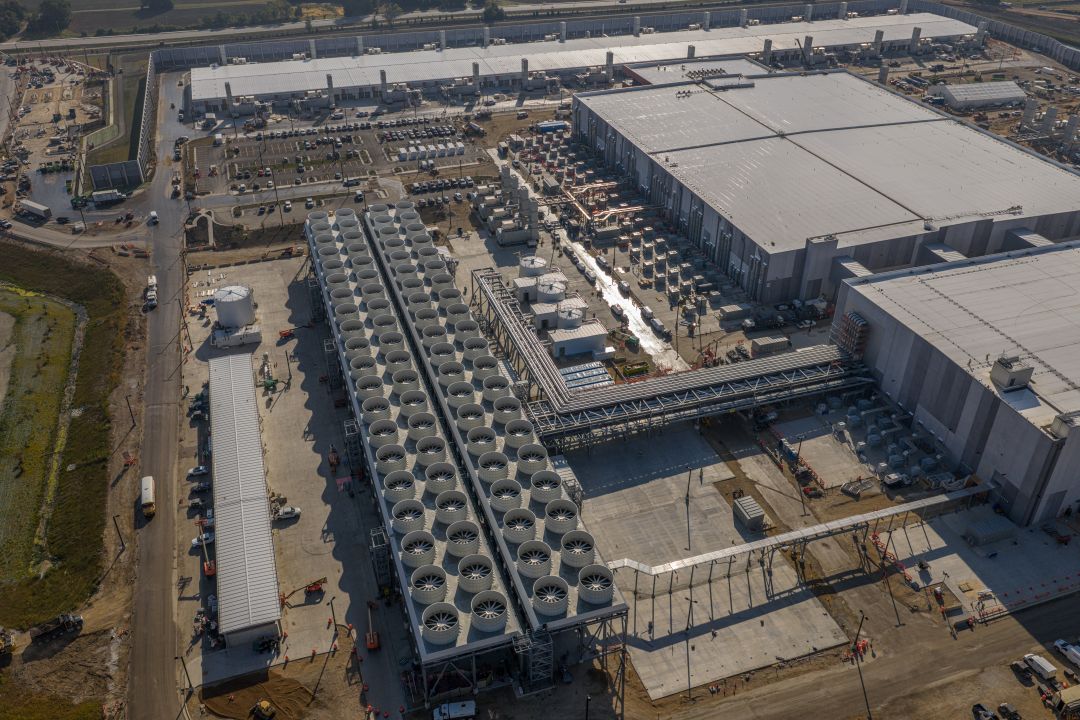
On a Schneider Electric–hosted visit to TeraWulf’s Lake Mariner AI campus, observers saw how AI is forcing data center design toward speed, scale and integrated full‑stack solutions.
Schneider’s Marc Garner framed the shift as “tokenization, converting compute into output,” and he predicts 36 percent of deployed compute will run AI workloads by 2030.
Builders face hard constraints from power availability and the energy transition, making large grid capacity allocations difficult and changing electrical and cooling architectures.
Rack densities are already around 150 kW and could reach 1 MW per rack in the next generations, driving liquid cooling adoption, consideration of 800V DC distribution, and urgent supply‑chain optimization; TeraWulf has shifted from Bitcoin mining to AI data centers since its 2021 founding.
Key facts:
- Visit to TeraWulf’s Lake Mariner AI campus hosted by Schneider Electric
- Marc Garner predicted 36 percent of deployed compute will run AI by 2030
- 150 kW rack densities are already in use today
- Feynman GPUs could push densities toward 1 MW per rack soon
- Transition to 800V DC distribution is on the horizon
Why it matters: Neoclouds, GPU‑specialized providers and full‑stack vendors such as Schneider stand to gain from faster, integrated builds and liquid‑cooling expertise that enable denser AI clusters.
Colocation operators and regions with constrained grid capacity risk higher costs, delays, or re‑architecting projects; monitor grid access, 800V DC discussions, liquid‑cooling supply chains, and evolving rack‑density reference designs.