Google rolls out five healthcare AI programs in Singapore; NHS England reports adoption and oversight gaps
Healthcare AI is moving from proposals into public systems, with Google coordinating five layers of deployment in Singapore and NHS sites already using decision-support tools in clinical care. The developments also show the limits of adoption: African antimicrobial-stewardship applications remain mostly experimental, while UK evaluations point to procurement delays and bias risks, making evidence, safety and oversight central concerns.
Tracking: Medicine Robotics · AI Medicine · AI Healthcare
Google Announces Five-Layer Healthcare AI Deployment Across Singapore

Google announced on Wednesday a coordinated healthcare-AI rollout across Singapore’s public health system, presenting it as the Asia-Pacific’s first simultaneous activation of five AI layers under one national framework.
The programs cover an AI co-clinician pilot with the National University Health System (NUHS), population-risk prediction and chatbot upgrades with NHG Health, on-premise MedGemma development, a Google Research hub with two universities, and pandemic-surveillance funding.
The clinical pilot is assistive, not a diagnostic replacement: its Planner supervises a patient-facing Talker and can escalate to a clinician.
In testing, doctors preferred it to GPT-5.4-thinking-with-search by 63% to 30%, but experienced physicians still performed better overall, especially at spotting red flags and guiding physical examinations; one serious safety error occurred across 98 queries.
Google also pledged $7 million, including $1 million for PathGen, an AI disease-surveillance platform intended to detect outbreaks before borders are crossed.
Key facts:
Why it matters: The significance is the breadth of the rollout: Google is placing clinical support, population prediction, local model development, research infrastructure, and outbreak surveillance within one public-health framework.
That gives Singapore a broad institutional test of how these tools work together, rather than evaluating an isolated chatbot or diagnostic system. The on-premise design addresses data-sovereignty concerns while supporting local clinical-AI development.
The early performance results also set a clear boundary: the system may help clinicians synthesize evidence, but its weaker performance on warning signs and physical examinations keeps human oversight central.
The next consequential test is whether the institutional pilots preserve that assistive role in real clinical workflows.
Commentary Says African AI Antimicrobial Stewardship Remains Mostly Experimental

A new commentary argues that artificial intelligence could strengthen antimicrobial stewardship across Africa, while concluding that the field remains at an early stage.
Most applications it assesses are still pilots or research projects rather than established practice. The assessment presents AI as a possible tool for improving how antimicrobial use is managed, but it does not establish proven impact at scale.
The immediate development is therefore evaluative: attention is shifting toward whether proposed systems can move beyond experimentation and generate evidence strong enough to support routine use.
For health leaders, the distinction matters because technological promise alone does not demonstrate clinical or public-health value.
Key facts:
Why it matters: The commentary highlights a gap between AI’s potential role in antimicrobial stewardship and demonstrated deployment.
Health systems and funders should treat current applications as developing interventions requiring stronger evidence, rather than as proven tools ready for broad adoption.
The next consequential step is whether pilot and research projects can produce reliable evidence supporting routine use. Until then, AI’s contribution to antimicrobial stewardship remains a prospect, not an established outcome.
UK Health AI Moves Into Practice, Exposing Gaps in Oversight
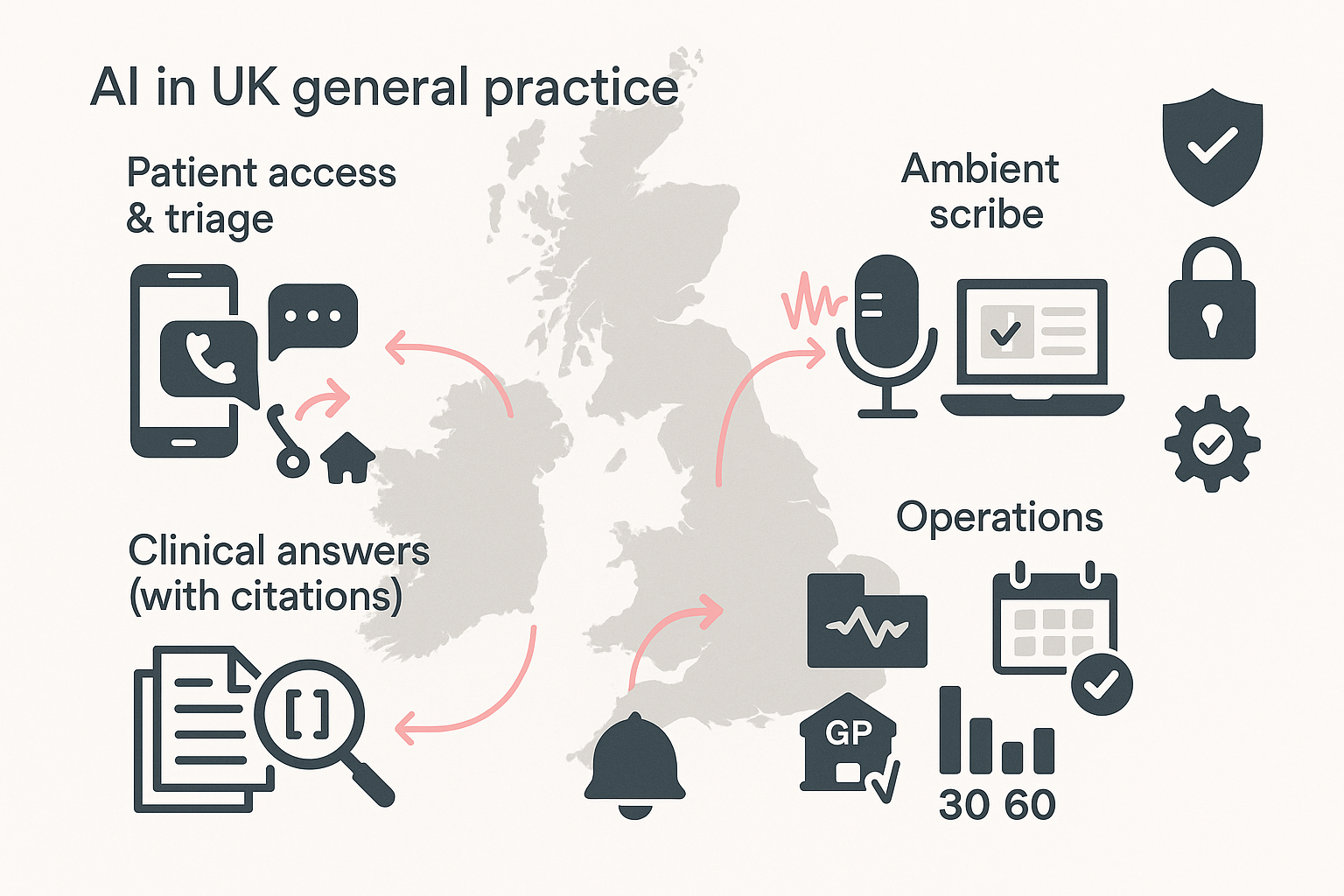
England’s NHS is no longer treating medical AI as a proposal: a new paper published October 29 describes decision-support systems already operating in stroke care, breast screening and chest diagnostics.
Across 107 stroke-admitting hospitals, an evaluation found higher thrombectomy rates at sites using AI relative to comparators; breast-screening studies reported performance non-inferior to human double reading, with simulated reading workload cut by about one-third.
Expansion has not removed implementation and safety problems. NHS England funded 12 regional imaging networks covering 66 trusts, but evaluation found procurement and deployment slower than expected.
A Department of Health and Social Care review found bias could enter medical devices from problem selection through post-deployment monitoring, strengthening the case for the paper’s risk-proportionate, evidence-weighted approach to oversight.
Key facts:
Why it matters: The immediate beneficiaries are services using decision support in stroke, screening and diagnostic imaging, but wider deployment raises the burden of validation, workflow integration and equity monitoring.
The evidence is also at different stages of maturity: stroke findings report a rate difference, breast-screening research includes retrospective and feasibility studies, and chest-AI rollout was slower than planned.
The next test is whether deployment becomes accountable at scale. Watch for procurement tied to stronger evidence, consistent post-deployment monitoring and safeguards against bias entering early design choices—not only model performance.
That is the practical importance of a risk-proportionate framework: oversight must reflect both the clinical stakes and the quality of evidence behind each tool.
Brooklyn middle school adopts three-year AI and robotics STEM plan

Joseph B. Cavallaro I.S.
281 in Brooklyn has published a schoolwide, three-year implementation plan for STEM technology, engineering, science, arts, and athletics.
It makes AI literacy, coding, robotics, ethical digital use, and problem-solving part of a broader seven-attribute framework for college and career readiness.
The plan assigns students practical work, including building autonomous robots, creating digital tools for community needs, and evaluating AI’s benefits, risks, and bias.
Its science track connects sensors, spreadsheets, simulations, and verified AI-assisted research with evidence-based inquiry, while identifying medicine, biotechnology, and laboratory work as career pathways.
The document emphasizes portfolios, project records, testing data, and public showcases as evidence of learning.
Key facts:
Why it matters: The plan’s direct healthcare significance is upstream: it gives middle-school students structured exposure to AI, robotics, evidence, and careers connected to medicine and biotechnology.
That could broaden the future talent pipeline for healthcare technology, but the document establishes an educational commitment rather than any clinical deployment or measurable workforce outcome. The next indicator is execution.
Student portfolios, debugging logs, research journals, testing data, and technology and engineering showcases will reveal whether the program translates its ambitions into demonstrable technical and critical-thinking skills.