Legally Briefed (Canada)
PublicCurated updates on recent Canadian court decisions, legal developments, and analysis from major legal databases for law firms and students.
Supreme Court hears Bill 21; sexual assault delays soar
Tuesday, Jul 14, 2026
This week's developments span Canada's legal system at every level: the Supreme Court grapples with Quebec's religious symbols ban under the Notwithstanding Clause, while a federal report reveals a 38% rise in sexual-assault case delays despite the Jordan timeline, with nearly 10,000 trials thrown out yearly.
Meanwhile, Ontario's appellate courts reject insurers' civil fraud defence, uphold a developer 'gag suit' ruling, and dismiss a getaway driver's appeal—and new free AI tools from CanLII and A2AJ promise to upend costly legal research.
The through-line is a system under pressure from constitutional clashes, procedural backlogs, and technological disruption, forcing courts and practitioners to adapt.
Tracking: Canadian court decisions · CanLII recent rulings · Westlaw Canada cases · LexisNexis Canada legal updates · Supreme Court of Canada judgments · Federal Court of Canada · Ontario Court of Appeal · British Columbia case law · Canadian legal news · common law updates Canada · site:canlii.
org recently-added date:2024 · Westlaw Canada recent decisions · LexisNexis Canada recent case law
Geography: Canada, Ontario, British Columbia
1. Supreme Court hears Quebec religious symbols ban challenge
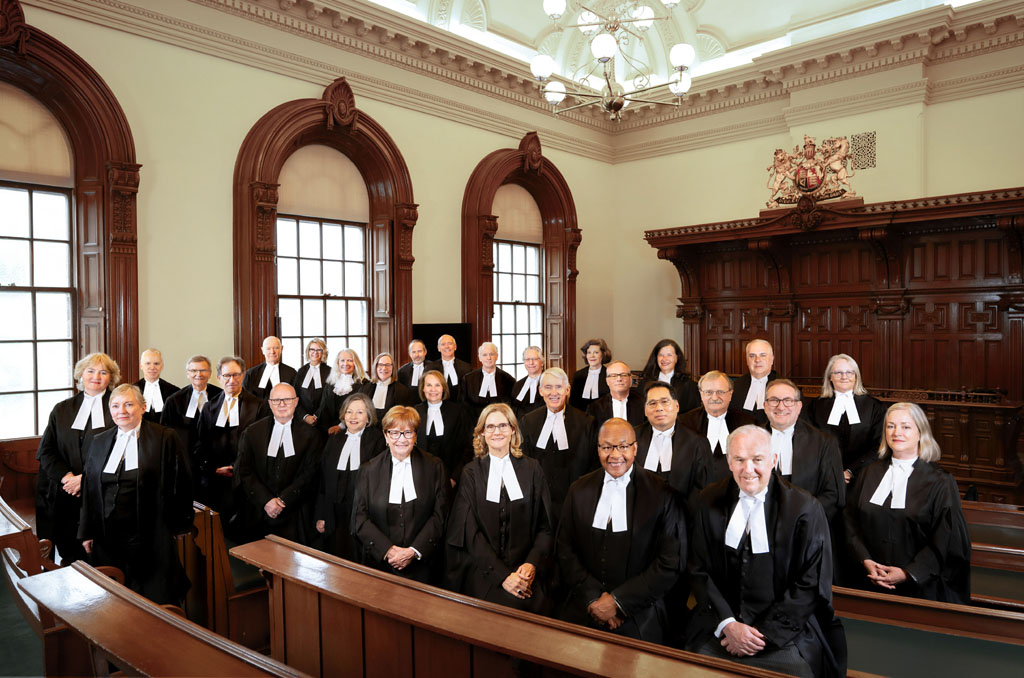
In March 2025, the Supreme Court of Canada heard four days of arguments over Quebec's Bill 21, which prohibits public servants in positions of authority—including teachers, police, and judges—from wearing religious symbols like crucifixes, hijabs, or yarmulkes.
The law, passed in 2019, asserts state secularism and is shielded by the Charter's Notwithstanding Clause.
The Canadian Conference of Catholic Bishops intervened, arguing that Bill 21 goes beyond Quebec's jurisdiction by imposing an anti-religious ideology that effectively amends the federal constitution without authority.
Their lawyer Philip Horgan did not challenge the Notwithstanding Clause but focused on the division of powers. Over 50 interveners participated, making it one of the longest Supreme Court hearings in history.
The decision is now pending.
Key facts:
- Supreme Court heard Bill 21 challenge in March 2025.
- Quebec law bans religious symbols for teachers, police, judges.
- CCCB argued Bill 21 amends federal constitution without jurisdiction.
- Over 50 interveners participated in the hearing.
- Notwithstanding Clause shields the law from Charter challenges.
Why it matters: The decision will clarify the limits of provincial authority to override religious freedom through the Notwithstanding Clause. A ruling against Bill 21 could restrict Quebec's use of the clause and set a precedent for other provinces.
Conversely, upholding it may embolden legislatures to pass similar secularism laws, reshaping the balance between federal constitutional rights and provincial powers.
The outcome also directly affects religious minorities and institutions, including Catholic, Muslim, and Jewish communities, whose visible faith practices are at stake in public sector employment.
2. Ontario Court of Appeal blocks insurers from adding civil fraud defence
The Ontario Court of Appeal has dismissed an appeal by two insurers seeking to add a civil fraud defence to their pleadings in a catastrophic injury case.
The underlying suit arises from a 2012 fall through an attic hole, where the insureds later admitted to fabricating evidence. The motion judge had denied the amendment because it would cause non-compensable prejudice to the injured plaintiff.
The appeal court found no reversible error in that prejudice finding, noting the insurers’ existing pleadings already allow them to argue the insureds’ lies.
The court also declined to rule on whether civil fraud is ever a valid defence under section 132(1) of Ontario’s Insurance Act. The insurers were ordered to pay $15,000 in costs.
Key facts:
- Case: Natario v. RBC Insurance Company of Canada, 2026 ONCA 482.
- Plaintiff sought $2 million in damages under s. 132(1) Insurance Act.
- Insureds fabricated evidence about the fall; insurers denied coverage.
- Appeal dismissed; insurers pay $15,000 in costs to the respondent.
Why it matters: The ruling clarifies that procedural prejudice can outweigh an insurer’s desire to add a fraud label, even when underlying misconduct is admitted. Insurers may now be more cautious about late-stage amendments in s.
132 claims. The decision also leaves unresolved whether civil fraud is a standalone defence under the Insurance Act, a question that could resurface in future cases.
For plaintiffs, the outcome strengthens protections against delay and tactical pleading shifts.
3. Ontario Appeal Court backs historic easement and developer 'gag suit' ruling
The Ontario Court of Appeal has issued two significant decisions in recent weeks.
In one, the court upheld a historic easement agreement within the Cressview Lakes Corporation in Caledon, resolving a dispute over a right-of-way between shareholders of adjacent cottage lots.
In the second ruling, the court upheld a lower court's decision in favour of University of Waterloo student Pierre Roy against developer Sheridan Retail Inc. , which had sued him for opposing a Mississauga mall redevelopment.
A judge described the lawsuit as a "quintessential gag suit aimed at curtailing public expression."
Key facts:
- Ontario Court of Appeal upheld an historic easement in Cressview Lakes, Caledon.
- Court also upheld a ruling in favour of Pierre Roy against Sheridan Retail Inc.
- Roy faced a lawsuit for opposing a Mississauga mall redevelopment in 2022.
- A judge called the developer's suit a "quintessential gag suit."
Why it matters: The easement decision clarifies property rights for landowners in cottage country, potentially affecting similar disputes over shared access.
The anti-SLAPP ruling strengthens protections for residents who speak out against developments, placing a higher burden on developers who use litigation to silence critics.
Watch for increased reliance on Ontario's anti-SLAPP law in planning disputes, and potential legislative or judicial responses from the development industry.
4. Sexual-assault case delays rise 38% despite Supreme Court timelines
A new federal Justice Department report shows the median time to conclude sexual-assault cases in Canada has risen to 453 days in 2023-24, up 38% from 328 days in the year of the Supreme Court's 2016 R. v.
Jordan decision. The Jordan ruling requires provincial cases within 18 months and superior court cases within 30 months, but the report found nearly 10,000 criminal trials are thrown out yearly for exceeding those deadlines.
Judges and Crown attorneys blame underfunded provincial justice systems, a 10% reduction in judges relative to population over two decades, and increasingly complex procedures from 2018 Criminal Code changes.
Ontario saw 48% of all cases withdrawn or stayed in 2023-24 due to deadline pressure, totaling 6,402 proceedings, an eight-percentage-point increase since 2016-17.
Key facts:
- Median sexual-assault case duration rose to 453 days in 2023-24.
- R. v. Jordan requires provincial cases within 18 months.
- 10,000 criminal trials are thrown out annually for delay.
- Ontario withdrew or stayed 48% of cases in 2023-24.
- There are 10% fewer judges relative to population than 20 years ago.
Why it matters: The rising delays undermine the Supreme Court's intent to guarantee speedy trials, leaving both complainants and defendants in prolonged trauma.
Underfunded provincial systems and outdated courthouses — especially in Ontario with only 146 courthouses for its population — risk more cases being thrown out, eroding public confidence in the justice system.
Watch for whether federal or provincial governments respond with increased funding to match judicial workload and infrastructure needs.
5. Ontario Court of Appeal dismisses getaway driver's bid for new trial
The Ontario Court of Appeal has dismissed a Mississauga woman's request for a new trial after she was convicted of robbery for acting as the getaway driver in a 2022 Cambridge cellphone store heist.
The three masked robbers had initially targeted a Scotiabank but abandoned that plan, instead robbing a Freedom Mobile store twenty minutes later.
The court found that the evidence, including cellphone searches and tracking data, supported the jury's guilty verdict. The woman, now 25, had been sentenced to 28 months in prison.
The appellate panel ruled that a trier of fact could reasonably conclude her guilt was the only logical inference from the evidence, which linked her to the planning and execution of the robbery.
Her boyfriend and another man were found in her car with firearms and the stolen phones.
Key facts:
- Robbery occurred Feb. 24, 2022, in Cambridge, Ontario.
- Robbers first entered a Scotiabank but left without acting.
- They then robbed a Freedom Mobile store, stealing cellphones.
- A tracking device in a phone led police to the getaway car.
- The woman's Acura SUV was seen following the stolen Honda Civic.
Why it matters: This decision reaffirms the low threshold for appellate intervention in jury verdicts: the Court of Appeal will not disturb a conviction if there is any reasonable evidence to support guilt.
It also illustrates how digital evidence—cellphone searches and tracking devices—can tie a getaway driver to a conspiracy even without direct participation in the theft.
For Canadian criminal law, the ruling clarifies that knowledge of the robbery's planning can be inferred from conduct before and after the event, narrowing the scope for appeals based on insufficient evidence.
6. Free AI tools and Claude Cowork transform Canadian legal research
Two new free tools are reshaping Canadian legal research, challenging costly platforms like Westlaw Edge and LexisNexis Protégé.
CanLII launched its Search+ AI in February, offering plain-language query translation and relevance rankings, but caps users at 10 searches and 4 analyses daily.
The Access to Algorithmic Justice project (A2AJ) released a free connector for ChatGPT and Claude, covering all SCC decisions since 1877, 25 years of Federal Court cases, and much of B.C. and Ontario Court of Appeal law, with no daily limits.
Separately, Anthropic's Claude Cowork—a $30/month desktop app—can now autonomously browse CanLII. org, run queries, and produce accurate case summaries.
In tests, Cowork outperformed Protégé by finding more recent and relevant decisions, including 2025 appellate cases on strip searches.
Both tools highlight a shift toward free or low-cost AI-driven research, though A2AJ and CanLII Search+ still face coverage gaps and interface limitations.
Key facts:
- CanLII Search+ launched in February 2026 with daily limits of 10 queries and 4 analyses.
- A2AJ's free connector includes all SCC decisions from 1877 and 25 years of Federal Court cases.
- Claude Cowork costs about $30 CAD monthly and runs searches on CanLII autonomously via Chrome.
- In tests, Cowork found 2025 strip-search cases; Protégé retrieved only cases from 2022 and earlier.
- A2AJ covers much of British Columbia, Nova Scotia, and the Ontario Court of Appeal, but has gaps.
Why it matters: These developments break the paid monopoly on AI-assisted legal research, giving small firms and self-represented litigants access to tools previously reserved for large firms.
CanLII Search+ and A2AJ are free but limited by daily caps or incomplete coverage, while Cowork offers full autonomy at minimal cost. The risk is reliance on AI accuracy: Protégé made factual errors, and Cowork missed some sources.
Watch for A2AJ to close coverage gaps, and for Westlaw and LexisNexis to respond with price cuts or improved features.
Generated by newsltr · 2026-07-14T16:26:42.438Z