Data Centres
PublicTracking the latest news on data centres.
NVIDIA revenue surges 1,300x as communities push back
Sunday, Jun 21, 2026
The explosive growth of AI data centers—epitomized by NVIDIA's 1,300-fold revenue surge—is colliding with local opposition over noise, water, and electricity costs, prompting moratoriums and lawsuits.
Meanwhile, a startup's $27M off-grid power system aims to sidestep both grid constraints and community backlash, highlighting a critical tension between national AI priorities and local quality-of-life concerns.
Readers should watch how regulatory battles and alternative power models shape whether the data center build-out can sustain its breakneck pace.
Tracking: Data Center · Data Centre
Geography: Northern Virginia, Silicon Valley, Dallas, Phoenix, Chicago, Frankfurt, London, Singapore, Tokyo, Dublin
1. Local communities push back against data center noise, pollution, and costs
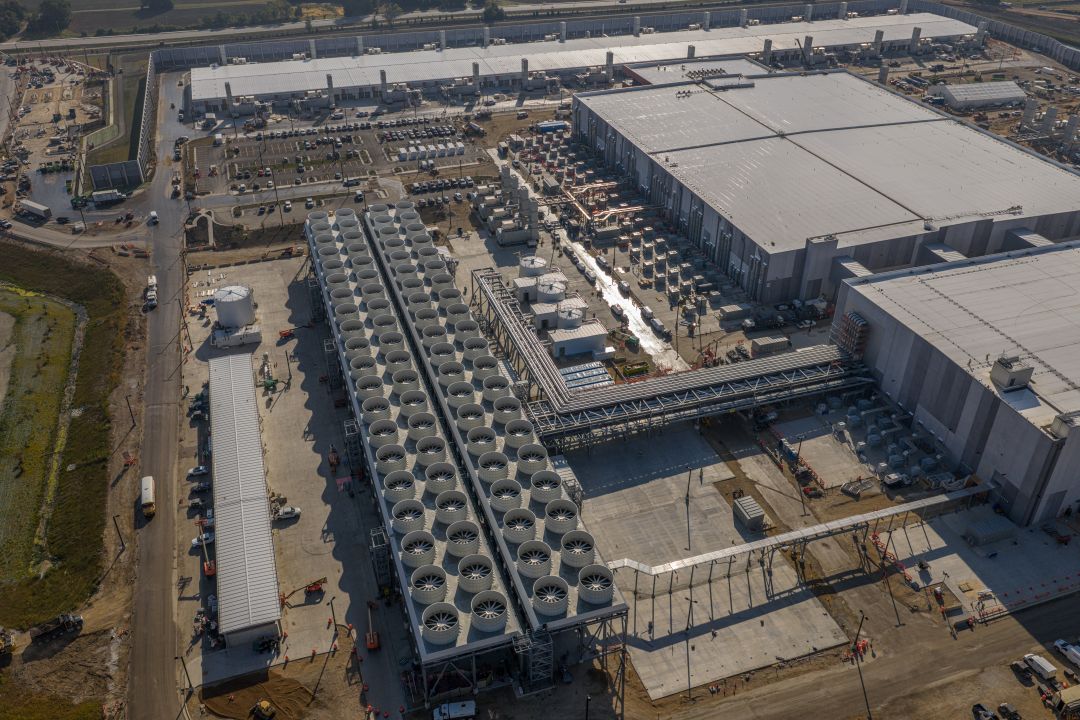
Across the United States, local governments are pushing back against a surge of data center proposals, citing noise, air pollution, high water consumption, and rising electricity bills.
Some counties and cities have imposed moratoriums on new data center construction to rewrite zoning and environmental rules.
Merrillville, Indiana, enacted a one-year pause, while Ypsilanti, Michigan, blocked water and sewer connections for data centers entirely.
Technology companies have responded by suing local governments that reject their projects, as seen in Saline Township, Michigan, and Chatham County, North Carolina.
Meanwhile, the Trump administration has identified data center build-out as a strategic priority and may ease federal regulations, creating tension between national goals and community concerns.
Key facts:
- Merrillville, Indiana, imposed a one-year data center moratorium.
- Ypsilanti, Michigan, halted water and sewer services for data centers in April 2026.
- Over 1,000 data center proposals are pending across the United States.
- Data center developers sued Saline Township, Michigan, and Chatham County, North Carolina.
- West Virginia passed a bill in 2025 reducing local zoning power over data centers.
Why it matters: The clash between hyperscale data center growth and local communities is likely to shape where cloud, AI, and edge infrastructure can be built.
If local moratoriums and lawsuits slow development, projects may shift to regions with weaker regulations or more incentives, altering the geographic distribution of data centers.
At the same time, federal efforts to accelerate build-out could override local control, raising questions about democratic decision-making and environmental justice.
Investors and operators should watch for policy changes in states like West Virginia and New Hampshire, as well as court outcomes in Michigan and North Carolina.
2. Startup Raises $27M to Bring Off-Grid Renewable Power to Data Centers
Texas-based startup TAR has raised a $27 million seed round to deploy modular, off-grid power systems for data centers, combining solar, batteries, wind, and backup gas turbines.
The company aims to address two critical issues: the massive power demands of AI-driven data centers and the growing local opposition to these facilities due to noise and energy competition.
Co-founder Pat Becker says the systems can provide 24/7 power without relying on the grid, with the first pilot delivering 10 megawatts on its own land and a customer deployment double that.
A recent simulation found that in 110 of 123 possible futures, lack of power—not chip shortages or model failures—was the main constraint on AI growth.
Meanwhile, residents in Dowagiac, Michigan report a 60-decibel whine from a local data center, and Lake Tahoe residents lost their power provider after NV Energy redirected supply to data centers. TAR’s model shifts assembly to factories to speed deployment.
Key facts:
- TAR raised a $27 million seed round.
- The company builds modular off-grid power systems using solar, batteries, wind, and backup gas turbines.
- Its pilot site will deliver 10 MW of constant power.
- In 110 of 123 simulated futures, lack of power is the main constraint on AI growth.
- A data center in Dowagiac, Michigan emits a 60-decibel whine in nearby yards.
Why it matters: TAR’s approach could ease a growing tension: AI expansion demands enormous energy, but data centers face local backlash over noise and power competition.
By offering off-grid, mostly renewable options, the startup may enable faster deployment in less populated areas, reducing conflict with communities.
However, the $27 million seed stage is early, and scaling to hyperscale demands will require proving reliability and cost.
What to watch: how quickly TAR moves to production-scale pilots, and whether utilities or hyperscalers adopt similar modular off-grid models.
If successful, this could reshape where data centers are built and how they source power, potentially easing grid strain in hotspots like Northern Virginia and Dublin.
3. NVIDIA data center and AI revenue surges 1,300-fold in 12 years
NVIDIA, which controls roughly 85% of the global AI chip market, has seen its revenue from data centers and AI explode from $57 million per quarter in early 2014 to more than $75 billion per quarter today.
This 1,300-fold increase flipped the company's revenue mix: data center and AI sales went from just 5% of total revenue to over 90%, surpassing gaming as the dominant segment. The growth pace accelerated after ChatGPT's launch in late 2022.
Before that, data center and AI revenue doubled every 16 months on average; since then, it has doubled every 11 months.
The numbers underscore how rapidly spending on AI hardware has grown, driven by cloud providers and AI companies building out massive computing infrastructure.
Key facts:
- NVIDIA data center & AI revenue grew from $57M to over $75B per quarter.
- Data center & AI share of NVIDIA revenue rose from 5% to over 90%.
- Revenue doubled every 16 months before ChatGPT, then every 11 months.
- NVIDIA holds about 85% of the global market for AI chips.
Why it matters: The explosive growth in NVIDIA's data center revenue signals a historic shift in computing investment.
Cloud providers and AI companies are spending enormous sums on GPU-powered infrastructure, which drives demand for new data centers, energy, cooling, and connectivity.
This trend has direct consequences for hyperscale operators, colocation firms, and regional data center markets, as well as for energy grids and sustainability efforts. The acceleration after ChatGPT shows that the AI race is still intensifying.
As companies compete to train and deploy ever-larger models, NVIDIA's chip dominance gives it outsized influence over the pace and direction of AI development.
Investors, regulators, and infrastructure planners will need to watch for supply constraints, rising energy costs, and potential shifts in chip demand as new competitors or specialized hardware emerge.